
Choreograph your visitor journey.
At a trade show, a visitor does not linger: they walk down an aisle, scan the space and decide within seconds whether to stop. Choreographing their journey means taking back control of those seconds: choosing where their gaze lands, where their steps carry them, and at which moment the visit becomes a conversation. A sequence of purposeful zones, each with its own intention, all the way to the crescendo.
A stand is not a stroll.
It is a sequence of intended encounters.
Nobody moves through a stand at random: every spot, every stop is designed to trigger the right encounter, at the right moment, with a piece of content, a product or an expert. Nothing is left to chance. It is not a set you walk through, it is a sequence of encounters you orchestrate.
Choreographing means applying a stage director's craft to a few square metres: deciding the order of the encounters, the contacts they generate and the emotion they leave behind.
No design without intention.
Three zones, five intentions.
Before a single piece of furniture, every zone is given an intention. The intention comes first; the mechanism follows, and that is what makes it real for the visitor. Five intentions, ordered in three stages: a single path — Attract, Qualify, Convert.
Zone 1 · Attract
The threshold.Attract
A signal visible from the aisle: sound, light, spectacle. You exist before anyone looks for you.
Zone 2 · Qualify
The engagement.Engage
The visitor does not watch, they do: active content, hands-on, play.
Personalise
Adapted to the profile: everyone receives the content that's actually relevant to them.
Zone 3 · Convert
The encounter.Convince
The proof shows itself: demo, screens, data, product in hand.
Meet
The summit: expert, forum, direct exchange with your teams.
The journey is drawn
before it is experienced.
Before the first wall goes up, everything is decided on the floor plan: where to attract, where to engage, where to convince, where to bring people together. Each zone is given an intention first, then the mechanism that embodies it. Here is a real plan, anonymised.
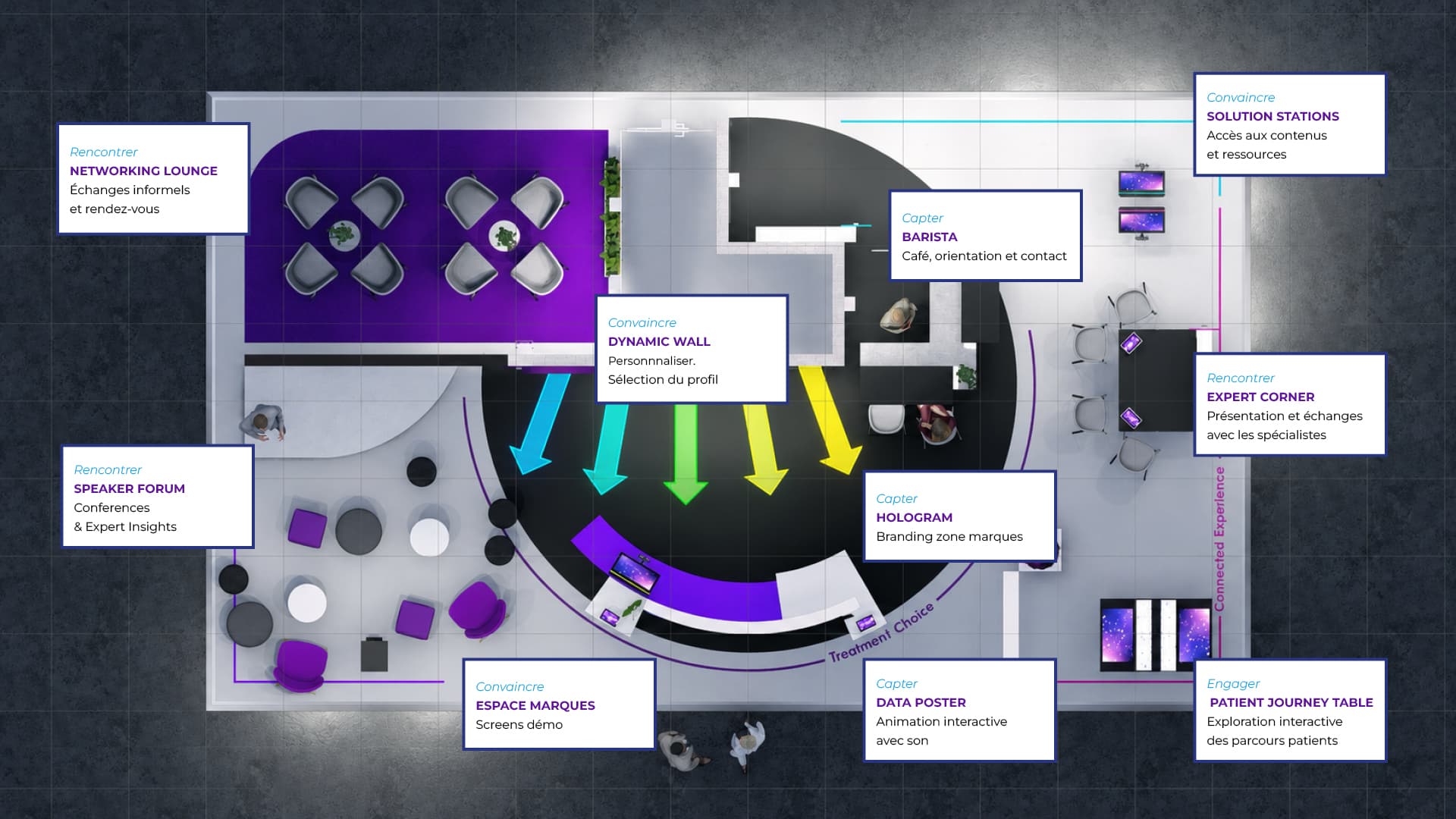
A well-orchestrated stand
becomes a stand that converts.
When every encounter is planned, visitors stay longer, arrive more receptive at the right moment, and you can spot at a glance the ones who deserve your teams' attention. The stand stops being a space you walk through: it becomes a sequence of encounters that leads all the way to the conversation.
 Preparing a trade show?
Let's talk about your journey, before we draw the stand.
The journey is designed early, while the plan is still a blank page. A one-hour conversation is usually enough to frame the intention, and to see whether you want to take it further together.